

Hire by Technology
SERVICES


Web3, blockchain, and decentralized finance (DeFi) are playing a major role in fintech innovation, and even changing traditional financial services, with the global value of blockchain solutions continuing to climb.
The shift to these technologies has been happening for a long time, and as a CTO or technical decision-maker of a fintech company or even a traditional financial institution, it is important to evaluate any changes in the financial industry and to decide if you are going to integrate these tools into your fintech services.
Let's take a look at the different applications of blockchain, Web3, and DeFi, including how companies are using these technologies securely and compliantly, even when integrating them with legacy systems, and where the actual center of gravity has shifted in 2026.
At Trio, we pre-vet fintech specialists who can help you integrate these changes.
Our developers are provided with all the required resources to stay current with the industry, keeping up to date with the latest regulatory changes, new industry standards for security, and shifts in user expectations so they can help our clients be at the forefront of the industry.
Web3 is the next step in the internet, one where users control their own data. As security and privacy become increasingly valued, users are demanding more control, particularly over their financial data.
Blockchain drives much of this shift, thanks to its distributed ledger system, which keeps data handling transparent without relying on centralized control.
Blockchain networks function as a backend driver behind data and transactions.
In fintech, blockchain platforms reduce the number of intermediaries companies rely on. This allows companies to cut costs and increases transaction speed for both users and providers.
This also makes it easier to produce verifiable ledgers, which can then be used to trace money and reduce fraud.
If your company deals with cross-border payments, asset custody, or trading, all of these benefits of blockchain platforms can help with regulatory compliance and increase user trust, which may bring in more clients over time.
DeFi matured into a genuine force in fintech, powering lending protocols, decentralized exchanges, insurance platforms, and asset management tools.
Using blockchain and cryptocurrency, DeFi can facilitate peer-to-peer transactions, with protocols like Aave and Uniswap using smart contracts to move money without a traditional intermediary.
What's changed more recently is where the institutional money and founder attention are going.
Infrastructure-focused startups now represent more than 70% of founder activity, shifting away from building parallel financial systems and toward rebuilding the existing one faster.
Real-world asset tokenization, converting equities, real estate, bonds, and other traditional assets into blockchain-based tokens, seems to be more of the industry’s focus right now.
That doesn't mean DeFi has stalled everywhere, though. Jurisdictions with clearer regulation, like Japan's revised crypto framework, have seen real institutional capital move into on-chain yield products from major financial institutions.
We’re seeing a handful of trends indicating the direction in which the industry could potentially be moving.
The sector as a whole is moving away from purely traditional operations to help meet changing demands. Decentralization is proving a real opportunity for fintech startups.
Smart contracts let fintech firms define and enforce logic directly on the blockchain, automating processes to reduce human error and cut out middlemen.
If firms use this technology correctly, they can create more enforceable agreements plus real speed. Real-time loan approvals and conditional insurance payouts are among the more common applications.
Widespread adoption has also surfaced real issues, though.
For example, fintech developers need contracts that are genuinely secure, with regular audits and testing to confirm they can't be manipulated.
Getting a blockchain specialist with proven fintech experience on the team matters here more than almost anywhere else in this space.
DAOs are changing how fintech technologies get governed and how capital gets managed.
They're essentially member-owned communities with no centralized leadership, relying heavily on smart contracts and voting. Governance rules are embedded directly into code for transparency.
If you are thinking of exploring community funding, collective ownership, or protocol-based governance, DAOs offer real lessons, particularly around designing secure voting mechanisms, incentives, and legal structures that hold up against fraud and other vulnerabilities.
Decentralized identity protocols help with KYC, user authentication, and fraud prevention.
Decentralized IDs (DIDs) and verifiable credentials let users share information on their own terms, letting you skip the limited, centralized databases that often left critical information missing.
Users now choose what to share, and can do so more easily. This makes onboarding simpler.
The added privacy emphasis has also increased trust in fintech applications specifically, where users are understandably wary about sharing sensitive information.
DeFi and blockchain applications used to be largely theoretical, but in recent years some major players have put these tools into production:
Before implementing blockchain in a fintech product, you need to know about a few real challenges up front.
Even though blockchain adoption isn’t new anymore, global regulation on digital assets and DeFi protocols keeps shifting.
Stablecoin regulation specifically has become considerably clearer in major markets over the past year, but plenty of adjacent territory hasn't.
A fintech specialist familiar with both international rules and the specific region you're operating in is worth having on the team, especially since failing to comply can mean real fines and lost user trust.
Smart contracts are still very susceptible to exploits, flash loan attacks, and oracle manipulation.
Even a contract that seemed fully secured needs regular auditing against current industry standards, spanning both the security architecture and a genuinely rapid incident response plan.
Blockchain platforms rarely operate in isolation. Integrating with existing systems that weren't designed for the new environment often means custom middleware, rethought user flows, and new approaches to data persistence.
Public blockchains offer real transparency, but that can mean exposing more transaction data than users are comfortable with.
Zero-knowledge proofs, off-chain storage, and permissioned ledgers are all worth considering depending on what your specific user base actually values around privacy.
Demand is growing, but there is still a very small hiring pool. Most roles demand cryptographic knowledge and regulatory awareness on top of solid engineering.
A hiring mistake here costs real time and money, which is exactly why working with a specialist partner tends to pay for itself.
Blockchain is still far from energy efficient overall, and while Proof of Stake chains have improved consumption meaningfully, sustainability concerns haven't fully gone away.
If you have an ESG mandate, or think you might need one in the future, you will need to think about this very carefully.
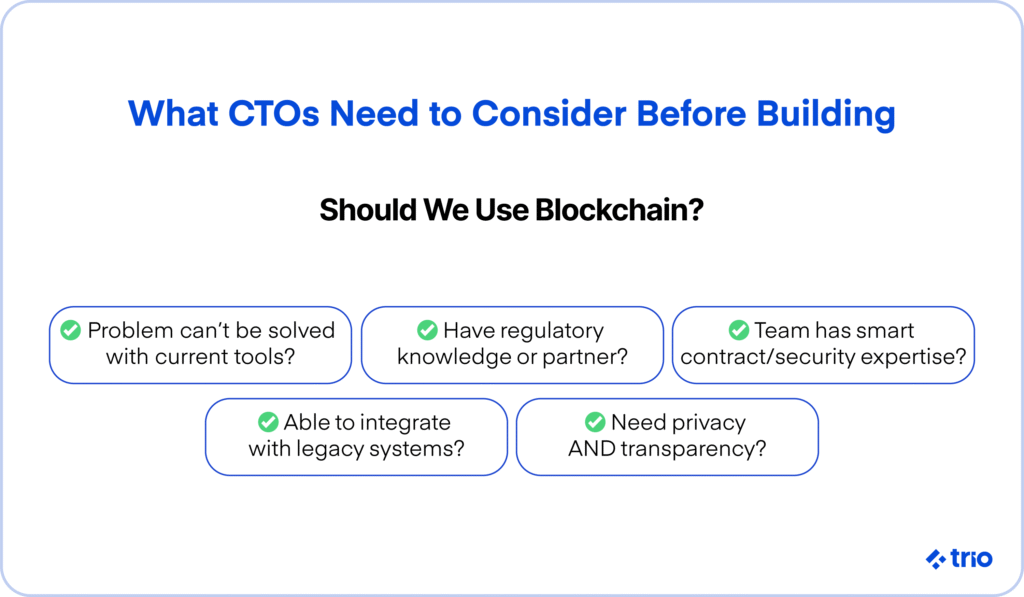
There are a couple of questions worth working through as a CTO or development leader before committing to a new blockchain tool:
Once you've decided to build, real decisions follow around your Web3 and blockchain stack, integrations, and compliance posture.
Outside of some basic smart contracts, a full Web3 stack needs wallets (where private keys and user access live, MetaMask and Fireblocks among the common choices), chains (Ethereum and Solana remain common hosts for application logic), oracles (feeding real-world data into contracts), and bridges connecting assets and logic across all of it.
You’ll either have to choose or build components that are genuinely secure and interoperable, or you'll run into real friction trying to work alongside other enterprise fintech systems later.
You can build everything from scratch, or use modular, pre-built protocols, SDKs, and APIs.
Modular systems are great for experimentation but can prove limiting. Full-stack solutions offer more customization and control, at real cost and real build time.
From what we have seen, most smaller fintech startups getting a first product to market are usually better served starting modular, then transitioning toward something more custom once there's budget to support it.
Retrofitting compliance onto a finished product is possible, but far from ideal.
Considering compliance from the start lets you build required features in from the ground up, including identity verification, transaction logging, audit trails, and data encryption among them.
An expert who understands the relevant regulatory frameworks and how to approach them practically tends to be cost-effective over the life of the product.
A few observable trends help predict where this heads next, even though the specific path isn't fully settled.
When evaluating a development partner, you need to look closely at experience on genuinely similar projects.
Working across both fintech and blockchain means your developers need real experience in regulated financial environments and blockchain development simultaneously, on top of the general engineering skill to build for scalability and maintainability.
Trio has developers with exactly this combination, which shortens a process that often takes months of job listings, interviews, and hopeful onboarding down to several days instead. Reach out to schedule a free consultation to see if our people are the right fit for your product.