Read Client Stories




 Alex Kugell
 Key Takeaways
- PHP powers 69.1% of all websites with a known server-side language and underpins 39.5% of all websites through WordPress.
- PHP 8 (now the 8.0 through 8.5 line) runs 66% of live PHP sites, which still leaves about a third on PHP 7 or older.
- Only 19.1% of professional developers report actively using PHP in the Stack Overflow 2025 survey, which creates tension with a massive installed base.
- US PHP developer pay sits near $102,005 a year on ZipRecruiter and $110,000 total pay on Glassdoor (both November 2026). LATAM senior PHP developers for US-facing roles typically cost $45,000–$70,000/year.
- Most PHP development work in 2026 is either WordPress customization and maintenance, Laravel application development, or legacy codebase maintenance and modernization.
Most of the web still runs on PHP, and yet it almost never comes up when a team picks a language for something new. That gap causes a lot of confusion about what PHP development actually involves now.
Three different situations send people looking into PHP web development, and they have little in common: building a new product, inheriting a codebase someone wrote years ago, or working out what a PHP developer should cost before hiring one.
This guide covers what PHP does on the server, which frameworks matter in 2026, where PHP turns up in fintech, what developers cost, and what to screen for when you hire.
If you need PHP developers for a fintech or web product, request a consultation.
What Is PHP Development?
PHP (which now stands recursively for PHP: Hypertext Preprocessor) is a server-side scripting language designed specifically for web development and embedded HTML.
PHP code runs on the server, not in the browser. The server processes the PHP, generates standard HTML, and sends that HTML to the client.
This server-side execution model is the basis for how PHP handles dynamic web pages, database queries, form processing, session management, and API responses.
Originally created by Rasmus Lerdorf in 1993 as a set of Common Gateway Interface (CGI) scripts and later released as PHP 3 in 1998, PHP grew into the de facto language of web development in the early 2000s.
A big reason for this was that it was easy to set up, paired well with MySQL, and shipped with most shared hosting environments. The LAMP stack (Linux, Apache, MySQL, PHP) became the default infrastructure for web applications for a decade and a half.
We still see a lot of this in legacy systems today, but the language has evolved considerably since then.
PHP 7 (2015) brought substantial performance improvements, with roughly 2x faster performance than PHP 5.6 and significantly lower memory usage, while PHP 8.0 (2020) introduced the JIT compiler, named arguments, match expressions, and union types.
PHP 8.1 added enums and fibers. PHP 8.2 and 8.3 brought readonly classes and typed class constants. PHP 8.4 (November 2024) added property hooks and asymmetric visibility, and PHP 8.5 (November 2025) added the pipe operator and clone with. Each release moves PHP closer to the type safety and expressiveness of newer languages.
With all of these changes, the result is a language that looks quite different from the PHP of ten years ago, making it worth a fresh look if you have evaluated it in the past.
What Is a PHP Developer?
A PHP developer builds, maintains, and extends web applications using PHP and the technologies that typically surround it. In practice, most PHP developers work in one of three contexts:
WordPress developers: building themes, plugins, and custom functionality within the WordPress ecosystem. This is the largest single category of PHP work by volume. WordPress’s plugin architecture means PHP developers here often work with the WordPress API, WooCommerce, and a range of third-party plugin ecosystems.
Laravel (or Symfony) application developers: building custom web applications and APIs using PHP’s modern frameworks. Laravel, built on top of PHP 8.x, has become the dominant PHP framework for new application development and produces clean, testable, maintainable code that compares favourably to Node.js or Django applications.
Legacy PHP maintainers: maintaining and modernising existing PHP codebases, often running on PHP 7.x or even older versions. An enormous amount of business-critical web infrastructure runs on PHP systems that weren’t built with migration in mind. Getting them upgraded, secured, and running on supported PHP versions is a genuine and ongoing business need.
PHP developers typically carry strong backend skills, and we have seen many of them branch into frontend work as well.
Most PHP applications also involve HTML, CSS, and JavaScript, and the line between backend PHP developer and full-stack developer is blurry in practice.
Build with Trio
Building your PHP development team?
Tell us about your application, existing stack, and the skills you need. We’ll discuss the right engineering support for your project.
Meet engineers from the Trio network


 Back-End Developer



These profiles show our network. We’ll confirm skills, fit, and availability for your project.
Tell us what you’re building
Share your requirements. Our team will follow up to discuss a match.
Thanks for reaching out.
Your inquiry has been saved. Our team will review your project details and follow up using the email you provided.
Back to TrioWhy PHP Persists: A More Honest Assessment
PHP’s continued dominance is occasionally treated as a mystery in technical circles, since it hasn’t followed the typical pattern of phasing out once newer technologies arrive.
There are several reasons for this.
First, the installed base is massive. When 69.1% of websites with a detectable server-side language run on PHP, there’s no practical route to migrate away from it. The cost and risk rarely justify it, so those systems end up being maintained in PHP instead.
WordPress also makes PHP unavoidable, since it sits on 39.5% of all websites and runs on PHP.
Every WordPress plugin, every WooCommerce customisation, every theme that does anything non-trivial requires PHP. The WordPress ecosystem alone creates more PHP development demand than most other ecosystems combined.
Laravel is also genuinely good. Laravel’s developer experience, with Eloquent ORM, Artisan CLI, built-in queue management, and Blade templating, is competitive with Rails or Django.
Instead of just settling, teams choosing it are making a legitimate architectural choice. Laravel 13 (March 2026) and the continuing development of Livewire and Inertia.js have extended Laravel’s reach into full-stack application development.
PHP 8.x closed the modernisation gap almost entirely.
The features added in the PHP 8.x line (JIT, fibers, enums, readonly properties, named arguments, match expressions, intersection types) have produced a language that handles most use cases competently and safely.
PHP Frameworks Worth Knowing
Laravel: the dominant PHP framework for new application development. Developer-friendly, opinionated, and well-documented. Strong ecosystem including Livewire (reactive full-stack without JavaScript bundlers), Inertia.js (SPA-style apps without a full API layer), and Laravel Forge/Vapor for deployment.
Symfony: the enterprise-grade modular framework. More opinionated about component boundaries than Laravel, and the foundation that Laravel itself builds on. Better suited for large, complex applications with multiple teams.
WordPress: technically a CMS rather than a framework, but the WordPress plugin and theme development ecosystem is effectively a PHP framework in the way it structures application code. WordPress PHP developers and strong Laravel developers have significantly different skill sets, so be careful when hiring.
Slim Framework: a micro-framework for building lightweight APIs and microservices. Where Laravel handles full-stack application complexity, Slim handles the other end: clean, minimal APIs with minimal overhead.
CakePHP: one of the older PHP frameworks with an active community. Less common than Laravel for new projects but still used in existing applications.
PHP Developer Roles and Responsibilities
A PHP developer’s day-to-day scope typically includes:
Building and maintaining server-side application logic in PHP, including API endpoints, business logic, and database interaction
Working with HTML, CSS, and JavaScript for frontend integration, or collaborating with dedicated frontend developers on the same codebase
Implementing database queries, schema design, and data migrations using MySQL, PostgreSQL, or other relational databases via PDO or ORM layers like Eloquent.
Writing unit and integration tests using PHPUnit
Maintaining and updating legacy PHP codebases by upgrading PHP versions, refactoring deprecated patterns, and migrating from deprecated mysql_* functions to PDO prepared statements
Debugging performance issues, identifying N+1 query problems, and implementing caching strategies using Redis or Memcached
Managing package dependencies with Composer and staying current with security advisories for dependencies
It’s important to note that, for fintech or other data-sensitive applications, PHP developers also need to handle sanitisation and validation of financial inputs correctly, implement proper authentication and session management, and understand the security implications of the systems they build.
Advantages of Using PHP
We have already touched on many of the benefits of using PHP, but it’s worth going into more detail to help you make a decision.
Open-source and free
PHP has no licensing cost, and its major frameworks (Laravel, Symfony) are similarly free.
Hosting environments that support PHP are widely available and also generally cheaper than platforms optimised for Node.js or Python.
Platform independent
PHP runs on Linux, Windows, and macOS and works with all major web servers (Apache, Nginx) without platform-specific modifications.
Large talent pool and community
PHP has one of the largest developer communities of any server-side language, thanks to how old it is and how much it is used in legacy software.
Stack Overflow, GitHub, and the Laravel/WordPress community forums contain answers to most questions you’ll encounter, so the documented history of solutions to PHP problems is extensive.
Strong database integration
PHP was designed with database interaction as a first-class concern.
PDO (PHP Data Objects) provides a secure, database-neutral abstraction layer. Eloquent (Laravel’s ORM) makes common query patterns readable and maintainable.
The LAMP/LEMP stack (Linux, Nginx/Apache, MySQL, PHP) is generally a very well-understood deployment pattern.
Legacy system maintenance
If your company runs existing PHP infrastructure, maintaining it in PHP is the practical choice.
The alternatives of rewriting all of your code in Node, Python, or Go carry significant risk and cost for systems that are working adequately.
PHP 8.x performance
JIT compilation in PHP 8.0 delivered meaningful performance improvements for CPU-intensive applications.
PHP 8.x is substantially faster than PHP 5.x and competitive with many newer alternatives for typical web workloads.
Where PHP Is the Wrong Choice
PHP earns its place on the web, and it still loses on a few problems that come up often enough to name.
Long-running processes and heavy concurrency: the request-per-process model suits short web requests. Services holding thousands of open connections, like live feeds or chat backends, sit more naturally in Go, Elixir, or Node.
Data science and machine learning: the libraries are not there. Python owns this one.
Mobile applications: PHP has no mobile runtime. It can serve the API behind an app and nothing else.
Core ledger and settlement engines: possible in PHP, though the pool of engineers who have built double-entry accounting in it is thin next to Java, Go, or C#.
There is a hiring reality worth keeping in mind too, since only 19.1% of professional developers report working in PHP, and that share has drifted down year on year. The people choosing PHP for new work are a smaller group than the installed base suggests.
PHP Developer Rates: US and LATAM Compared
US PHP developer pay depends on which source you trust.
ZipRecruiter puts the average at $102,005 a year as of November 2026, while Glassdoor reports a median total pay of about $110,000. The middle 50% on ZipRecruiter sits between $83,000 and $115,500, with the 90th percentile at $131,000.
Laravel and Symfony specialists typically cost as much as 15–25% more than the general PHP average, reflecting genuine scarcity relative to demand.
Salaried pay at that level works out to roughly $49/hr. US contractors tend to bill above it, commonly $60 to $80/hr, since their rate has to cover benefits, downtime, and their own taxes.
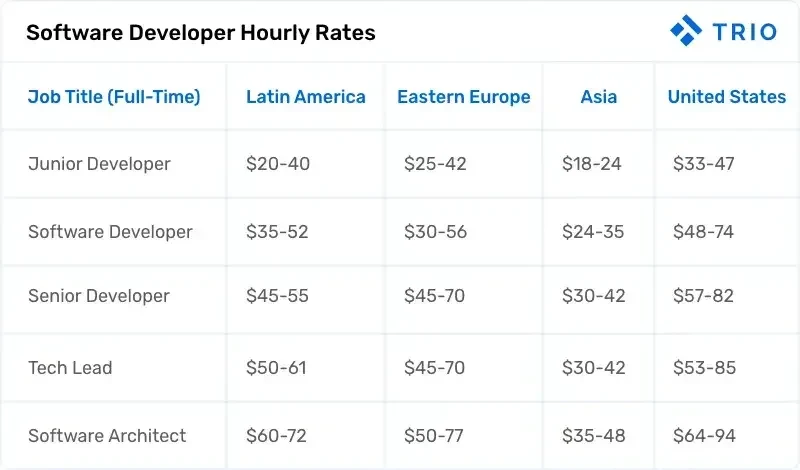
LATAM nearshore rates are significantly cheaper:
Seniority | US annual | LATAM annual | LATAM hourly |
Junior (0–2 years) | $65,000–$85,000 | $22,000–$36,000 | ~$18–$30/hr |
Mid-level (2–5 years) | $85,000–$115,000 | $36,000–$52,000 | ~$30–$46/hr |
Senior (5+ years) | $115,000–$145,000 | $45,000–$70,000 | ~$40–$65/hr |
Lead / Laravel specialist | $145,000+ | $65,000–$90,000 | ~$58–$80/hr |
What to Look For in a PHP Developer
The specific skills worth screening for depend heavily on the context of the role:
For Laravel application development
If you are specifically looking for a Laravel developer, you’ll need to look for proficiency in Laravel 12 or 13, Eloquent ORM, queues and jobs, Blade and Inertia/Livewire, testing with PHPUnit/Pest, and Composer dependency management.
Laravel 10 and 11 both dropped out of security support by March 2026, so a CV that stops at Laravel 11 tends to mean someone who has not shipped new work for a while.
It’s important that you ask candidates to walk through how they’d handle a complex database query with multiple relationships.
Eloquent’s eager loading and the N+1 problem are a common area where experience separates strong candidates from inexperienced ones.
For WordPress development
For more traditional websites built on the CMS, they’ll need an understanding of WordPress hooks and filters, the WP_Query API, custom post types, plugin and theme architecture, and WooCommerce if relevant.
WordPress and Laravel are genuinely different contexts; a strong Laravel developer may have minimal WordPress experience and vice versa.
For legacy codebase work
Familiarity with PDO and prepared statements (vs deprecated mysql_* functions), PHP version migration paths, and the ability to modernise code incrementally rather than requiring full rewrites.
General PHP competency across contexts:
Modern PHP 8 features: named arguments, enums, match expressions, readonly properties, fibers, and property hooks from 8.4
Object-oriented PHP: classes, interfaces, traits, abstract classes, dependency injection
PDO and prepared statements (not raw query concatenation, which remains a source of SQL injection vulnerabilities)
MVC architecture and separation of concerns
Testing with PHPUnit
Composer and package management
Understanding of REST API design and implementation
Working with MySQL or PostgreSQL, including query optimisation basics
Version control with Git and familiarity with CI/CD pipelines
For fintech or compliance-sensitive applications, it is critical that you also screen for input validation and sanitisation practices, understanding of session security, and awareness of the OWASP Top 10, particularly SQL injection.
SQL injection in particular stays disproportionately common in PHP codebases that build queries by concatenating strings rather than using prepared statements.
Supporting Legacy PHP Applications
A significant portion of PHP development work in 2026 involves maintaining and modernising systems built on older PHP versions.
For example, PHP 5.6 reached end-of-life in December 2018. PHP 7.4 reached end-of-life in November 2022. PHP 8.0 followed in November 2023 and PHP 8.1 in December 2025, which means anything below PHP 8.2 now runs unpatched. PHP 8.2 itself loses security support on 31 December 2026. Applications still running on these versions receive no security patches from the PHP community, creating a meaningful operational risk.
This risk is even more pronounced for any system handling financial data or personal information.
The practical path forward for most legacy PHP systems is incremental modernisation:
upgrading the PHP version (which often requires resolving deprecated function usage and syntax changes)
migrating from mysql_* functions to PDO
introducing or expanding automated testing to make the migration safe
refactoring toward the class-based, dependency-injected patterns that modern PHP favours
This work requires developers who understand both old PHP patterns (so they can read the existing code) and modern PHP practices (so they can move the codebase toward them), which is an entirely different skill set from greenfield Laravel development.
PHP and Fintech: Where It Appears
PHP isn’t the first language that comes to mind for fintech development. Instead, most new fintech infrastructure gets built in Node.js, Python, Java, or Go.
But PHP appears in the fintech context more than the developer survey numbers suggest:
Payment gateway integrations: Stripe, PayPal, and Braintree all maintain official PHP SDKs, and a large number of e-commerce and payment-accepting applications are PHP-based.
Fintech dashboards and admin tools: Internal tools, reporting systems, and admin panels for financial products are frequently built in Laravel or Symfony, which play to PHP’s strength in server-side rendering and database integration.
Legacy financial systems: Banks, credit unions, and financial services companies with systems built in the 2000s and 2010s often have substantial PHP codebases that require maintenance and careful migration.
For PHP developers working on financial applications, the same domain knowledge considerations apply as in any fintech context.
They need a solid understanding of why monetary amounts should never be stored as floating-point types, that payment flows require idempotency controls, and that database queries touching financial records need to be correct before they’re fast.
Hiring PHP Developers Through Trio
At Trio, we place pre-vetted PHP developers from LATAM with US companies, including teams maintaining or building on PHP infrastructure for fintech and e-commerce products.
These engineers have 4–8 hours of daily US time zone overlap, making synchronous code review and architecture discussions practical.
Our staff augmentation model places engineers as embedded team members who work in your codebase, with your code review process, and your deployment workflow.
They can be placed in 3–5 days at $40–$80/hr.