Read Client Stories





 Alex Kugell

 Key Takeaways
- JavaScript runs nearly everywhere now, including browsers, servers through Node.js, mobile apps through React Native, desktop apps through Electron, and edge networks.
- Most professional JavaScript is written as TypeScript, which adds static types on top and catches a category of bugs before the code runs.
- The browser is still where it matters most, since no other language runs natively there, which is the structural advantage nothing has displaced.
- JavaScript is not the fastest language, and single-threaded execution makes it a poor fit for CPU-heavy work, though the heavy lifting usually happens elsewhere anyway.
- Node.js suits I/O-heavy services well, which covers most API work, and suits computation-heavy services badly.
- In financial software, JavaScript dominates the interface layer while core transaction processing usually runs elsewhere, and knowing why is useful when you hire.
JavaScript started as a scripting language for making web pages react to clicks.
These days, it runs servers, mobile apps, desktop software, build pipelines, edge functions, and a fair amount of machine learning, and it has topped Stack Overflow’s most-used language rankings for over a decade.
Let’s take a look at what JavaScript is actually used for, where TypeScript fits into the picture, and the things it remains a poor choice for.
At Trio, our experienced developers use JavaScript for a variety of tasks, including in heavily regulated industries like fintech.
What Is JavaScript?
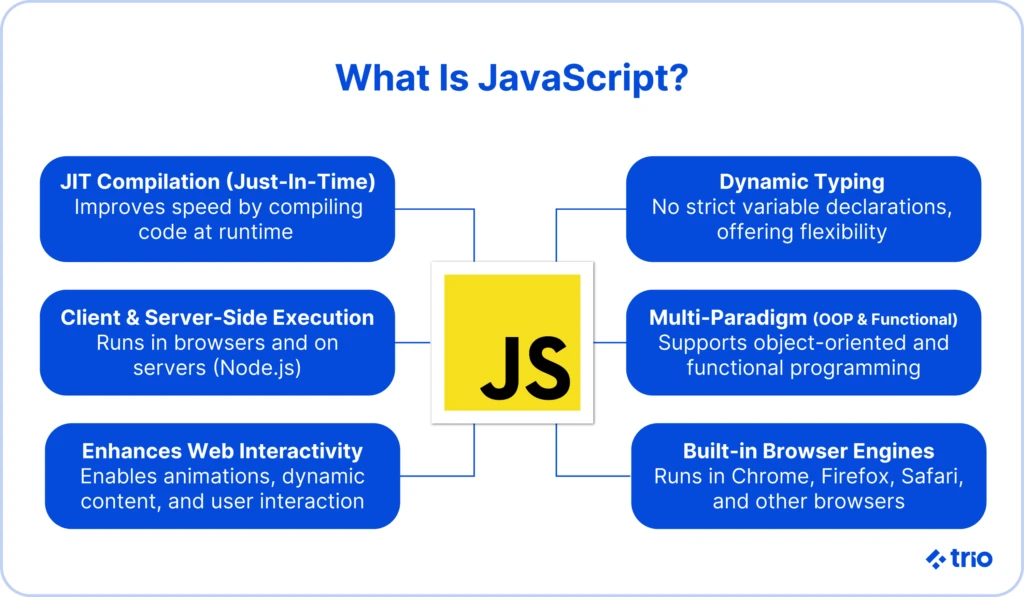
JavaScript is a just-in-time compiled, multi-paradigm programming language with dynamic typing.
Brendan Eich wrote the first version in 1995 at Netscape, famously in about ten days, which explains a few of its quirks.
Alongside HTML and CSS, it forms the third pillar of the web. HTML provides structure, CSS provides presentation, and JavaScript provides behavior. Before it existed, web pages were documents rather than applications.
Two technical properties shape how it feels to use. Just-in-time compilation means code gets compiled during execution rather than ahead of time, giving you the flexibility of an interpreted language with much of the speed of a compiled one. Dynamic typing means variables do not declare a type, which speeds up writing code and moves a whole class of errors from compile time to runtime.
That second property is precisely what TypeScript exists to address.
Where does TypeScript fit in?
Most JavaScript written professionally in 2026 is TypeScript. TypeScript is essentially JavaScript with static types added.
It compiles down to ordinary JavaScript, so it runs anywhere JavaScript runs, and the types exist only during development.
What you get for the extra annotation is errors caught before the code executes, along with editor autocomplete that actually knows what your objects contain.
interface Payment {
amount: number;
currency: string;
reference?: string;
}
function formatAmount(payment: Payment): string {
return `${payment.amount.toFixed(2)} ${payment.currency}`;
}
For example, if you were to pass an object missing currency, your editor would flag it immediately rather than production doing so later.
From what we have observed, adoption is close to universal at the professional end.
React, Angular, Vue, Node frameworks, and most serious libraries all ship type definitions, and plenty of teams treat plain JavaScript as acceptable for scripts and unacceptable for anything that has to be maintained.
If you are thinking about learning JavaScript, don’t worry too much. TypeScript is not a separate language. It’s just JavaScript plus a type system, and valid JavaScript is valid TypeScript.
8 things JavaScript is used for
There are many things that JavaScript can be used for, but we have narrowed it down to about eight categories.
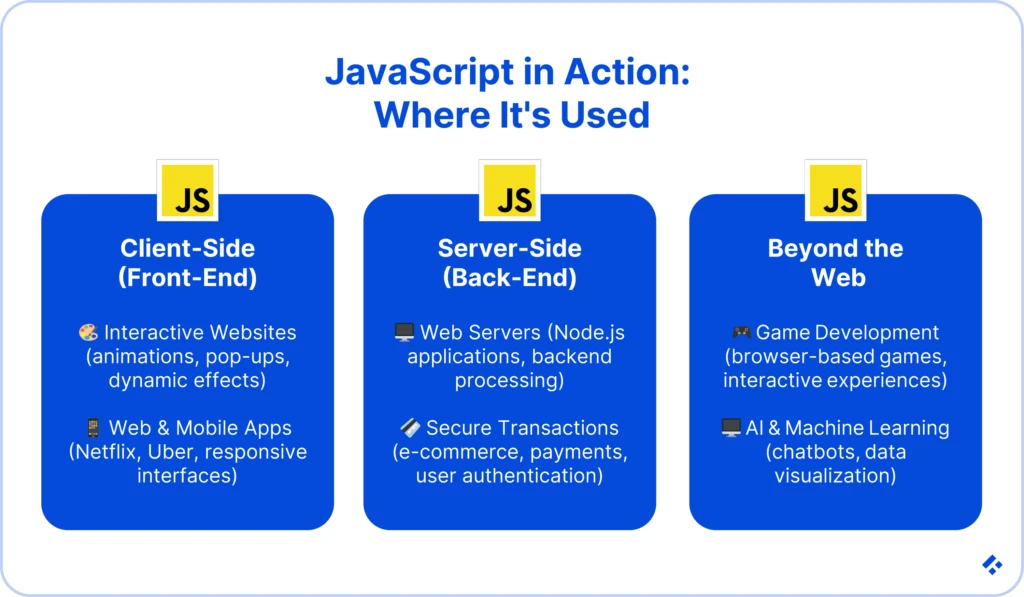
1. Client-side web development
This was the original job, and it’s still the biggest one.
Every interactive element you touch in a browser probably runs on JavaScript. This includes things like dropdown menus, search autocomplete, form validation, content that updates without a page reload, image carousels, and even video controls.
No other language runs natively in a browser.
WebAssembly, for example, lets other languages execute there for performance-critical work, but it does not manipulate the page directly without JavaScript alongside it. That monopoly is the structural reason JavaScript’s position has never meaningfully eroded.
Most front-end work now happens through a framework like React, which holds the largest share, with Vue, Angular, and Svelte behind it, and a layer above those (Next.js, Nuxt, SvelteKit, Astro) that allows you to handle rendering strategy, routing, and data loading.
2. Server-side development
Node.js took JavaScript out of the browser in 2009, and the main consequence was one language across the whole stack rather than two.
Node suits I/O-bound work particularly well. Its event loop handles many concurrent connections without a thread per request, which fits APIs, real-time services, and anything spending most of its time waiting on a database or another service.
Express, Fastify, and NestJS are the common frameworks.
Two newer runtimes are worth knowing about.
Deno was built by Node’s original author with security defaults and TypeScript support built in.
Bun optimises hard for startup and install speed and has gained real traction.
3. Mobile app development
React Native compiles to genuinely native components, so a React Native app renders real platform views rather than a web page in a wrapper. Instagram, Shopify and Discord ship parts of their apps this way.
Ionic and Capacitor take a different route, running a web application inside a native shell, which trades some performance for closer parity with web development.
Angular is a web framework, not a mobile one, but we also see it power the web layer inside an Ionic app. Just keep in mind that it cannot build native mobile applications by itself.
4. Desktop applications
Electron bundles a Chromium browser and Node together so a web application can ship as a desktop app across Windows, macOS and Linux.
Visual Studio Code, Slack, Discord and Figma’s desktop client all use it.
There are a couple of things worth being careful about, though.
Electron apps use considerably more memory than native equivalents, because each one ships its own browser.
Tauri addresses that by using the operating system’s existing webview with a Rust backend, producing much smaller binaries.
5. Build tooling and developer infrastructure
JavaScript is a lot less visible when used in build tooling and developer infrastructure, but it is used constantly.
In reality, most of the tools that bundle, transpile, lint, test, and deploy modern applications are mostly written in JavaScript or consumed through it.
Vite handles development servers and bundling, ESLint and Prettier handle code quality, Jest, Vitest and Playwright handle testing, and npm remains the largest software registry in existence.
However, we’re seeing a noticeable shift underway here, toward tools written in Rust and Go for speed, though they are still driven through JavaScript configuration.
6. Edge and serverless computing
JavaScript turned out to suit edge execution unusually well.
Cloudflare Workers, Vercel Edge Functions, Deno Deploy and AWS Lambda@Edge all run JavaScript at locations close to the user, with startup measured in milliseconds rather than the seconds a container takes.
This matters for anything latency-sensitive, like personalization, authentication checks, redirects, API routing, and A/B tests. The constraint is that edge runtimes are not full Node environments, so some packages will not work there.
7. Game development
Browser games run on JavaScript, usually through an engine.
Phaser covers 2D, Three.js and Babylon.js handle 3D through WebGL, and the WebXR Device API extends into virtual and augmented reality.
JavaScript is not the language of AAA game development and does not pretend to be. For browser-delivered games, prototypes, and interactive 3D on the web, it has no real competition.
8. AI and machine learning
A smaller role than Python’s, and growing for a specific reason.
TensorFlow.js runs machine learning models directly in a browser or in Node, which keeps data on the user’s device rather than sending it to a server.
For anything privacy-sensitive, that property is worth a lot. Transformers.js does something similar for language models.
The larger pattern is integration rather than training.
Most AI features in applications involve calling a model API, orchestrating retrieval, and streaming responses into an interface, all of which happens in JavaScript because that is where the interface lives.
Things like the Vercel AI SDK and the official Anthropic and OpenAI JavaScript libraries exist for exactly this.
What is JavaScript not good at?
Balance helps here, and there are definitely things that JavaScript is not good at.
CPU-intensive computation: JavaScript executes on a single thread. Heavy calculation blocks everything else, including the interface. Web Workers and worker threads help by moving work off the main thread.
Memory-constrained environments: Garbage collection introduces pauses you cannot schedule, which rules JavaScript out for hard real-time systems and most embedded work.
Type safety by default: Dynamic typing moves errors from compile time to runtime, which is why TypeScript exists and why most teams adopt it once a codebase passes a certain size.
Dependency weight: The npm ecosystem’s breadth is a genuine strength and a genuine liability. A modest project can pull in hundreds of transitive dependencies, each one a maintenance and security surface.
Ecosystem churn: The pace of change in JavaScript tooling is faster than most ecosystems.
JavaScript in financial applications
Financial software splits along a fairly consistent line.
The interface layer is overwhelmingly JavaScript, including banking dashboards, trading interfaces, payment checkouts, onboarding flows, and lending applications.
The transaction core usually is not. Payment authorization, ledger writes, and settlement tend to run on Java, Go, or C++, where predictable latency under load and strong typing at the language level matter more than development speed.
Node sits comfortably in between, handling API layers, orchestration between services, and real-time features like live balance updates over WebSockets. That I/O-bound profile is exactly what the event loop handles well.
When you are writing in a regulated environment specifically, just keep in mind that TypeScript stops being optional, because a type error in a payment amount is a different category of problem from a type error in a blog layout.
On top of that, dependency auditing becomes a compliance requirement rather than good practice, since you have to know what is in your supply chain. And accessibility conformance is frequently a legal obligation.
Why do teams choose JavaScript?
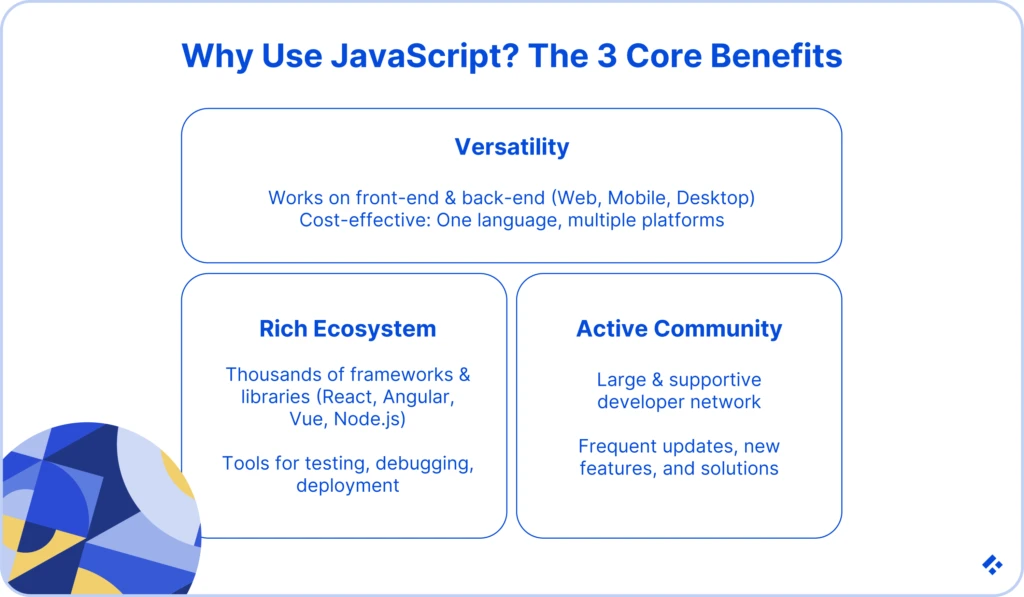
Browser compatibility is effectively universal: Whatever else changes, the thing that runs in every browser on every device is JavaScript.
One language across the stack: A team can share code, types, and people between front end and back end, which reduces handoffs and makes it easier to move an engineer between layers.
The hiring pool is the largest of any language, which cuts both ways: easier to recruit, harder to filter.
The ecosystem covers nearly everything, with a package for most problems and frequently several, maintained actively enough that an unmaintained library is usually replaced rather than endured.
Finding JavaScript developers
Someone building React interfaces, someone writing Node services, someone optimizing a build pipeline, and someone shipping React Native apps all share a language, but there is a lot that differs between these roles, so make sure you go hire for the right role.
It’s also worth asking about TypeScript explicitly, since the gap between a developer who uses it and one who has only worked in plain JavaScript shows up quickly in a codebase that has to last.
At Trio, we place senior JavaScript developers and React developers with production experience in regulated financial environments, through staff augmentation or as a dedicated team.
If you are scaling a front-end team or scoping a project, request a consult.